
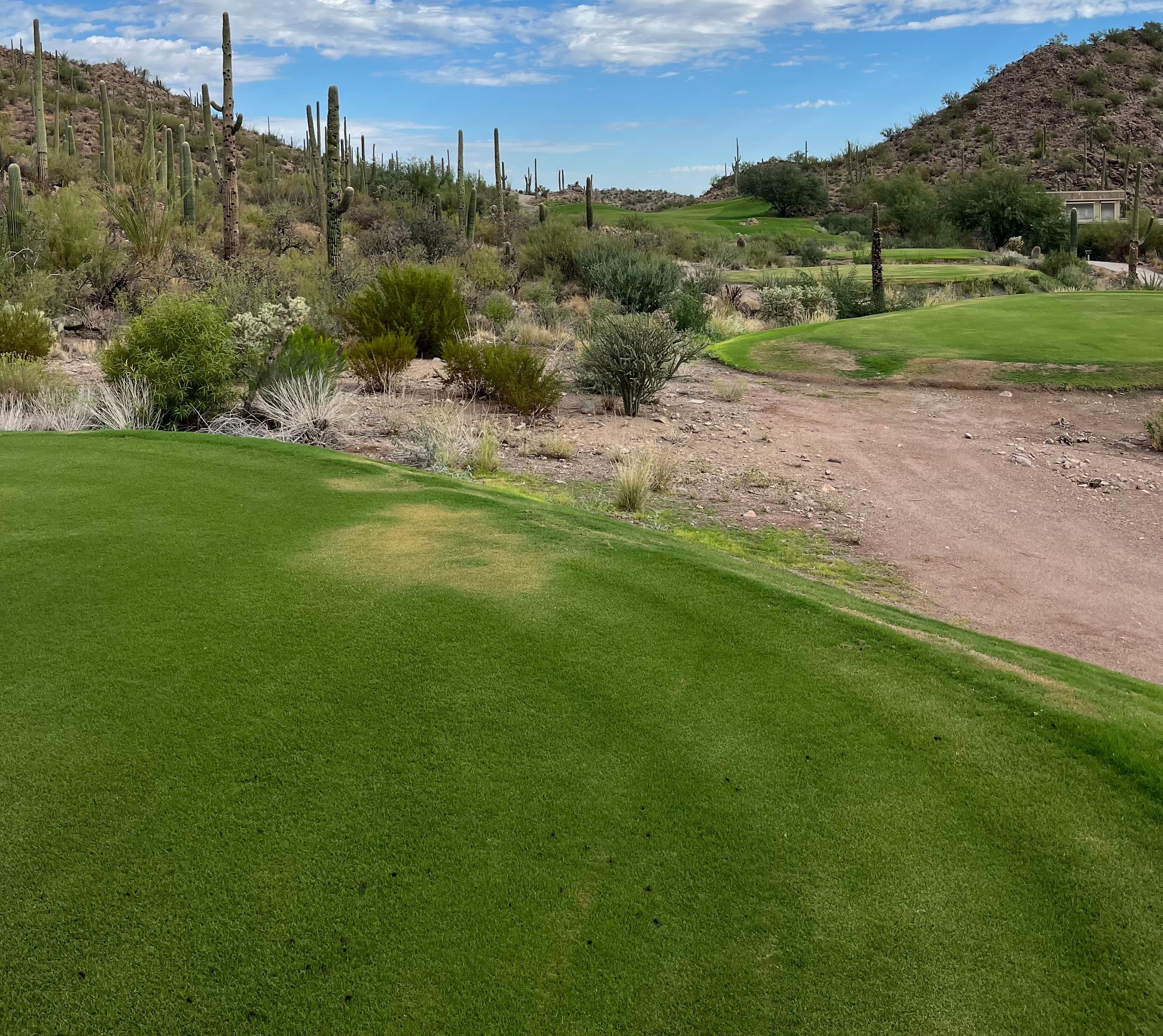

Before Q-School began, I took a trip to Tucson to scout a new Second Stage site. Applicants rank each of the five host courses for Second Stage based on preference, and for players advancing through First Stage—or those exempt directly to Second—the choices matter. The Club at Starr Pass is new to the rotation, and there wasn’t much reliable information available. With the course less than two hours from Phoenix, and Young the Giant—a band that has set the tone for many of my practice sessions—scheduled to play an old downtown Tucson theater, I loaded my family into the car and headed southeast.
I arrived at Starr Pass the next morning still buzzing from the concert. The perfect notes that carried me onto the property were about to fade away. I knew the course was carved through the desert and draped across hillsides, but I wasn’t prepared for just how narrow, blind, and uncomfortable some of the holes would be.
As I checked in, a guy working in the cart-staging area struck up a conversation. “Most of the tee shots are irons,” he said. He wasn’t good enough to play Q-School himself, but he knew the course well. “It’s not a bomber’s course. It makes you think. It’s more of an old school plotter’s place.”
Starr Pass is the only Second Stage site under 7,000 yards, but with par at 70, players are still going to face the test of their lives.
A walk around the property made clear how punishing it will be. Wayward shots bleed into rocky, unforgiving desert where the best-case outcome is often a chip-out. Anything more aggressive risks tangling with sharp cholla or saguaro, which stand like armed Spartans awaiting an attack.
Most balls headed toward the desert won’t be seen again. Several tee shots are completely blind, forcing players to aim at distant mountains or at a cactus just beyond the tee. On some holes, the fairways look like narrow green bridges suspended over hostile ground. Every shot requires adding or subtracting significant yardage for elevation. “Not a fun walking course,” one player said. The greens are small, many perched atop knobs, like tiny boats rocking on stormy green seas.
Long-hitting Tucson native Gavin Cohen, a Korn Ferry Tour member last season, picked Starr Pass as his top choice precisely because he believes many players will be discouraged. Longer Second Stage venues might better suit his game, but he thinks local knowledge counts for more here.
Three weeks ago, the Asher Tour hosted a Second Stage warm-up event. Over three rounds, Ollie Osborne shot 10-under and won a playoff—yet only 16 of the 67 players finished under par. Scores ballooned. Two players shot 5-under in the opening round, but no one went lower than 4-under in rounds two or three. New PGA Tour member Sudarshan Yellamaraju missed the cut, as did longtime Korn Ferry pro Josh Creel and established mini-tour names like Michael Feagles, Charles Reiter, Cameron Sisk, and Jhared Hack. I can’t recall seeing so many notable names miss a mini tour cut.
Hack, who contended seemingly every week on the mini tours this year, rarely makes bogeys. But in the Asher event, he made a double and a triple on consecutive holes in Round 2. He shot 70–75 and missed the cut by four. The new greens don’t behave as expected, he said.
“It’s like landing on an astroturf green,” Hack explained. “It doesn’t bounce—it hits, goes flat, and runs forward like a six-iron. It’ll roll 40 feet. A sand wedge will land flat, jump 10–15 feet, then grab.” Hack feels more comfortable now after a few practice rounds and believes the course plays to his strengths.
“Feels like it’ll be a war of attrition out there,” said Jared du Toit, a former PGA Tour Canada winner caddying for Cameron Sisk this week. He expects some early-week wind and guessed that anything under par for four rounds would be enough to qualify. “Rock-hard greens and soft over-seed fringes. Some tee balls are a little claustrophobic.”
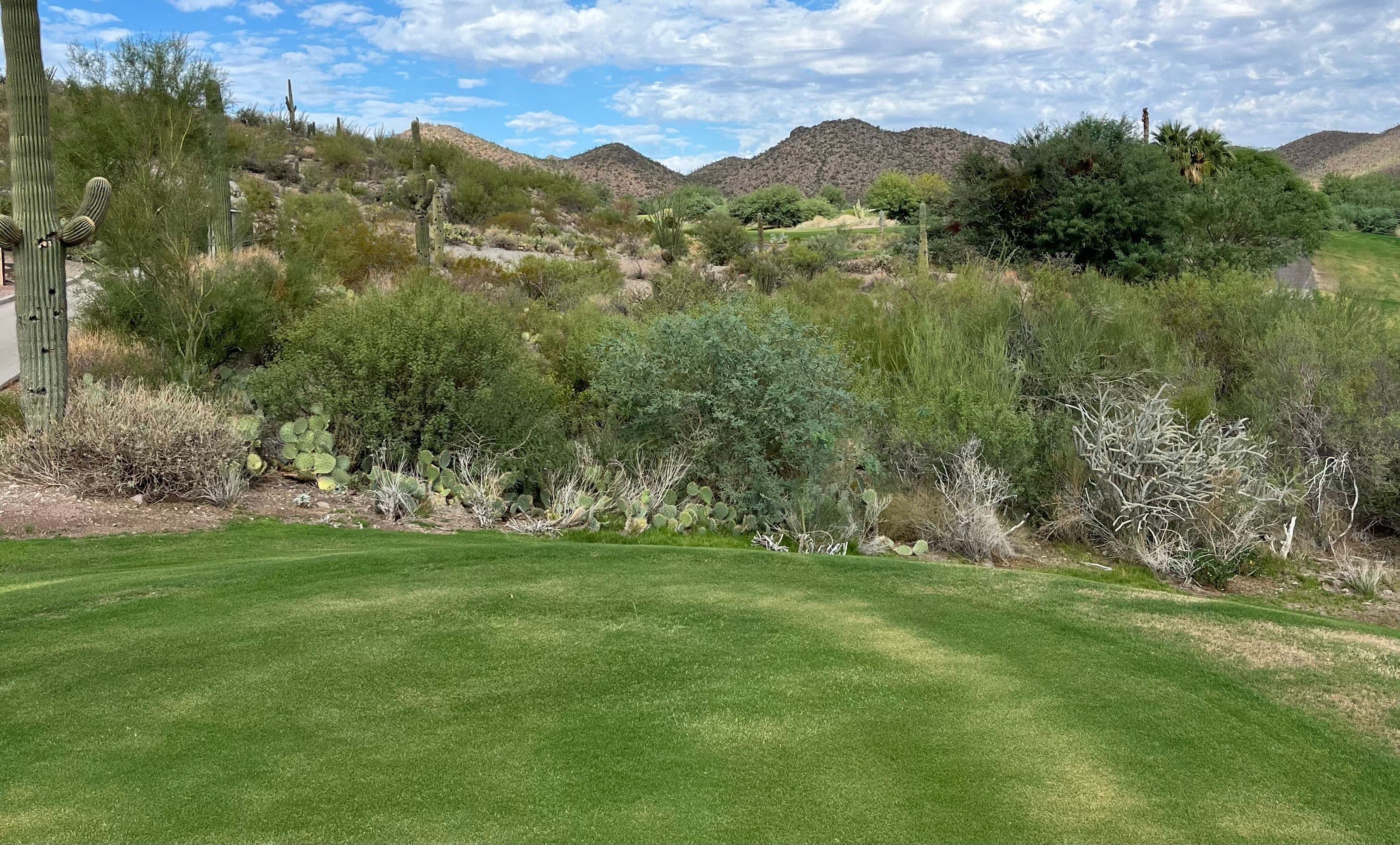
Starr Pass is one of those rare courses where pars are good scores. Hack agreed with du Toit’s projection, predicting the magic number will fall somewhere between even and four-under. Double-bogey avoidance is always critical at Q-School—but it may matter most here.
“Most important thing might be keeping my player in play,” du Toit said. Keep your ball on grass.
As my scouting trip wrapped up, I imagined the feeling of a final round at Starr Pass with my future on the line. I left the course anxious. I won’t be competing this week, but I’ll be watching—and writing—from a safe distance, relieved.


Comments
...