


Real golf fans know Amen Corner. They know why bailing out right of the green on 11 isn’t a bad miss, how the swirling winds on 12 play tricks, and how Rae’s Creek on Sunday can appear as vengeful as the Congo River. Then there are more subtle challenges of Augusta National. The ones not seen on TV.
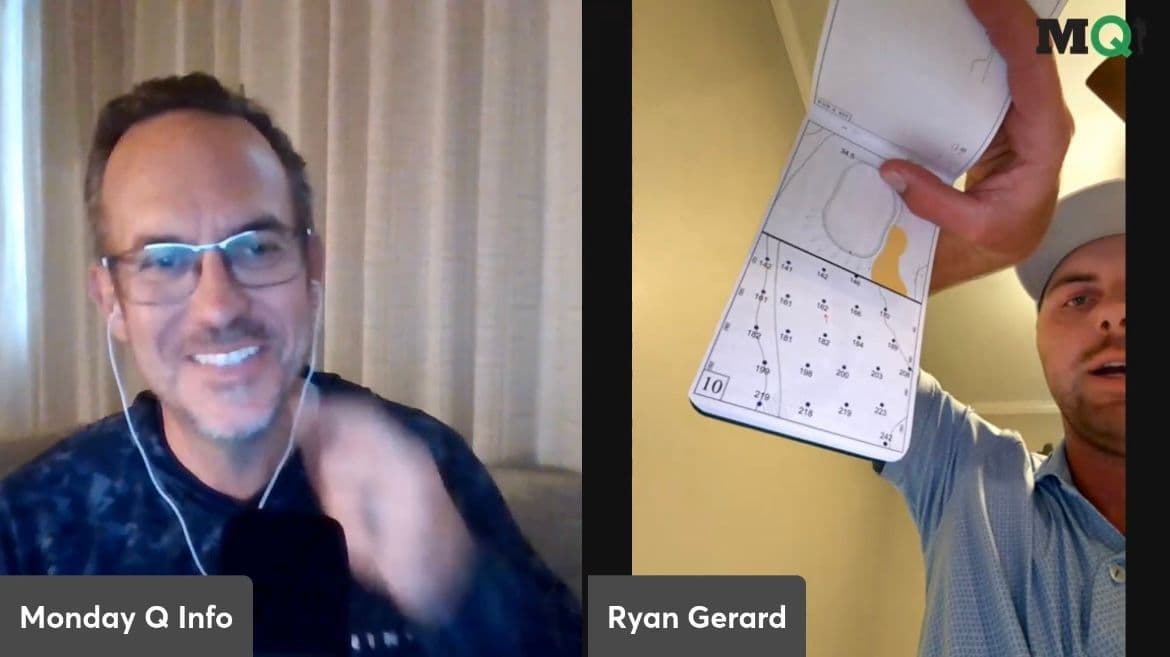
Ryan Gerard is making his first Masters start this week and he joined Any Given Monday to discuss how he prepared. Gerard played three rounds at Augusta on two different occasions before tournament week. The trips were the payoff of a 30-hour adventure to the AfrAsia Bank Mauritius Open in December, where he moved into the OWGR top-50 and secured his Masters exemption. Earning a bid to Augusta at the end of last year allowed Gerard to begin learning the course early – and he’s discovered the devil is in the details.
One of the most underrated challenges, Gerard says, is the grain. He explained Augusta National’s grass is mowed away from every putting surface, meaning most shots are into the grain. “They mow everything back into you,” Gerard says. “It doesn’t really affect a ton on full shots, but it just magnifies slight errors in what you’re doing.”
You’ve seen it before – those alternating light and dark stripes in a dewy fairway. Dark means the grain is into you. Light means it’s downgrain. At Augusta, the blades are almost always into you, leaving little margin for error.
“A slight mishit normally, you might get away with it,” says Gerard. “Here, if you slightly mishit it, you’re going to pay the price.”
Think of it like the traffic spikes at the entrance of a rental car lot: easy to drive in, dangerous to drive out. Around the greens, being into the grain makes each shot less predictable.
“Every chip is basically into the grain,” Gerard says. “You’re never really feeling like, ‘Oh yeah, I got one, I can just lay the face open and spin it.’”
To a tour player, a golf ball laying downgrain might as well be on a tee. The sole of a club easily slides through impact without interference. This type of lie gives a player maximum control. Those crowd-pleasing pitches where the ball drives low, skips and stops on a dime – that was likely played from a downgrain lie. Into the grain is a very different story.
“The ball could come out a little slow, ride up the face, come out with less spin, and just kind of trundle,” says Gerard.
A ball resting into the grain sits between the blades. Grass can get caught between the ball and clubface at impact, reducing spin. Because the heel of a club easily dig on chip shots – causing mishits and chunks – some players will stand closer to the ball in their setup, or rest the club more on its toe at address. Players will be planning chips with less spin and more roll this week.
“Grain changes the way you approach certain shots,” Gerard says. “And here, when you have to be really precise to really tight areas, you just have to be aware of that.”
At Augusta, the challenges are big and small – and every blade of grass matters.



Comments
...