


Michael Feuerstein was over par and taking a penalty drop after hitting his tee shot in the water on the short par-4 11th at Dallas Athletic Club’s Blue Course. Any other day, it would have been easy to shrug off the cut tee shot that rode a gusting wind into a watery grave. But this wasn’t any other day. It was the final qualifying for the U.S. Open, and Michael shot three-over par in his morning round.
To add insult to injury, I told him I thought his ball might be okay. When in doubt a caddie should follow the tried-and-true rules: show up, keep up, shut up. I should have paid more attention to the last one.
After the sunken tee shot, Michael had to drop and play a 130 yard wedge over a few tall trees. The section of the green where the pin was cut was no more than 12 yards deep. “You sure this is the perfect yardage (for the drop)?” I asked as he dropped the ball. He was sure.
I was caddying on “golf’s longest day,” and with wind gusts reaching nearly 30 mph, it had been a grind.
Michael is a late-blooming journeyman from Southern California and has become a good friend. The 42-year-old made his first-ever cut on the PGA Tour at the ONEflight Myrtle Beach Classic last year. At the 3M Championship Monday qualifier a couple months later, Feuerstein fired a 62 to earn a spot in his second PGA Tour event of the season. Before the year was over, he added another made cut at the DP World Tour’s AfrAsia Bank Mauritius Open.
Michael started a campaign to help raise money for high school golfers in need through Drive Fore The Future this year. Donations spiked during local qualifying: Michael medaled at Brentwood Country Club in Los Angeles with six birdies and a lone bogey. His swing coach planned to caddie at final qualifying, but a scheduling conflict arose and Michael asked if I would substitute loop.
I haven’t carried my own golf bag for a full round in years, and I was supposed to play a tournament in Phoenix the day after qualifying. I had one question as I considered carrying a bag for 36-holes in the Dallas heat: Can I take a push cart?
My trolley was granted and we rolled into Dallas with high hopes.
A day before qualifying, Sergio Garcia watched the PGA Championship in a grillroom at Dallas Athletic Club. Five small tables were surrounded by people watching a television that appeared undersized for the room. Burgers sizzled. The hotdogs rolled on the grill. I sat with Michael at one of the tables comparing course notes.
Garcia made the cut at last year’s PGA Championship and last played in the U.S. Open in 2024, finishing 12th, seven shots behind winner Bryson DeChambeau. I wondered what the 46-year-old felt as he watched. Determination? Regret? Or was he just hungry?
Garcia came out of the grillroom in good spirits as I stood with two outside services employees.
“Sergio shook my hand and talked like he knew me today,” one employee said. The tone had effervescence. Despite what the man might have thought before, Sergio had made a fan for life.
“That’s what they do,” said the other employee. Sergio drove a cart range to prepare for the coming test.
The field for final U.S. Open qualifying in Dallas was stacked: PGA Tour members, a U.S. Open champion, LIV and Korn Ferry Tour winners, journeymen, grinders, teaching pros and dreamers. Nine players in the field of 116 were 36 holes away from a spot in the U.S. Open at Shinnecock Hills. Dallas is one of 16 qualifying sites that will finalize the field at this year’s national championship.
The weather called for steady 20 mph winds with high gusts, making Dallas Athletic Club’s two courses stout tests. Michael had spent two days the previous week learning the golf courses. On Sunday, he focused on short game practice, conserving energy and finalizing strategy.
The alarm rang early on Monday. I arrived in the dark for the 7:09 tee time on the Gold Course to get pin positions marked in our yardage books. I recognized almost everyone on the range. There would be no faking it into the U.S. Open on this day.
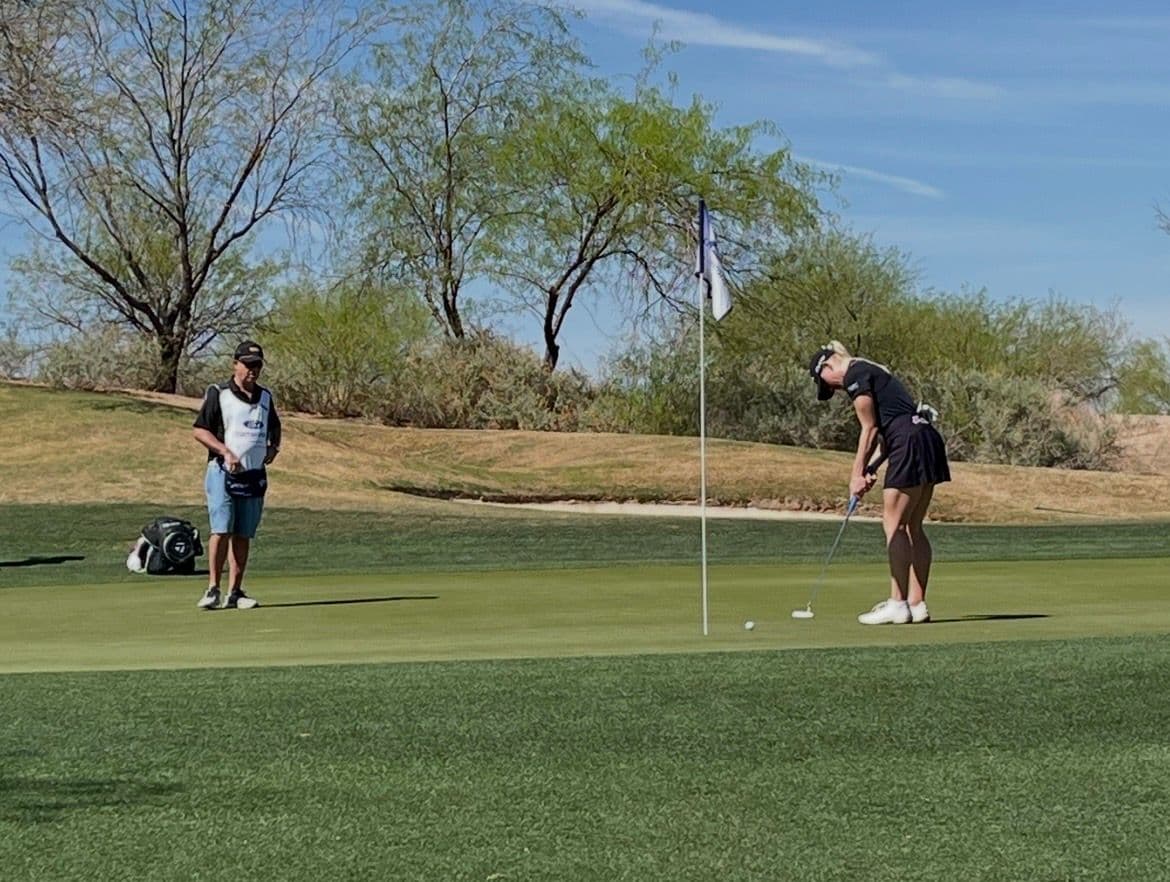
On the par-5 third hole, Michael was short-sided in two and had a delicate chip to an elevated green. The ball came off his lob wedge low and skipped 18 feet past the flag. He was faced with a glassy birdie putt with a few feet of break and a freshening wind at his back. A putt that rolled two feet past the hole had a chance to go off the green; a nerve-testing way to start the day.
His ball broke and gathered speed. It made the briefest effort to slow before rolling 12 yards off the green. Shock turned to dread on his face as I handed him his wedge. He was probably the first player to putt it off the third green on this day, but definitely not the last.
“Regroup and pitch this in,” I said.
Again, his chip came out low and took a big skip forward. This time, the hole got in the way and the ball disappeared. I let out a surprised, relieved laugh. “Routine five!”
His normally smooth putting stroke rarely looked comfortable after that. Momentum can change at any moment in this crazy game.
Another reminder of that came at the ninth, when a chip came to rest on a slope 10 feet short of the hole and a gust blew the ball back to Michael’s feet. He didn’t chip the next one in. Double bogey.
He fought back, regaining those lost shots, but a bad tee shot on the final par-5 of the day cost us another double bogey. A birdie there would have likely meant an under par score for the round. It was a momentum-crusher. Michael signed for a three-over 75, well off the pace needed to contend.
In the afternoon, Michael needed a near perfect round to have a chance. On his second hole (the 11th on the Blue Course), he hit his tee shot in the water. “I think it’s okay,” I said, putting my foot in my mouth as I looked through my old rangefinder. Our hopes for qualifying began sinking with the ball. That’s when Michael produced the shot of the day.
He took a drop, chose his club and swung. The ball made a melodic sound off the clubface and never left the flag. It pierced through the wind, landed near the hole and disappeared.
A member of the group walking towards the green raised his hand.
“Did it go in?” Michael asked.
“I think it went in.”
A few seconds later another player confirmed: he had holed it.
Michael flashed the same relieved smile from the third hole that morning.
“Routine three,” I said with a laugh.
Michael shook his head in disbelief. Crazy game.
Unfortunately, that was the final heroic moment of the day. Most players can’t qualify for a U.S. Open when their game is fractionally off and putts aren’t falling. It wasn’t our day.
As player and caddie, you rise and fall together. But the disappointment cuts deeper and lingers longer for a player. Part of a caddy’s job is making sure that feeling isn’t carried alone. That’s also a friend’s job.
In the end, nine players qualified. Everyone else went home replaying what might have been. A better bounce here and a made putt there. Many spent the night torturing and consoling themselves: I was close.
Perhaps next year they’ll find a better caddie.
Comments
...