
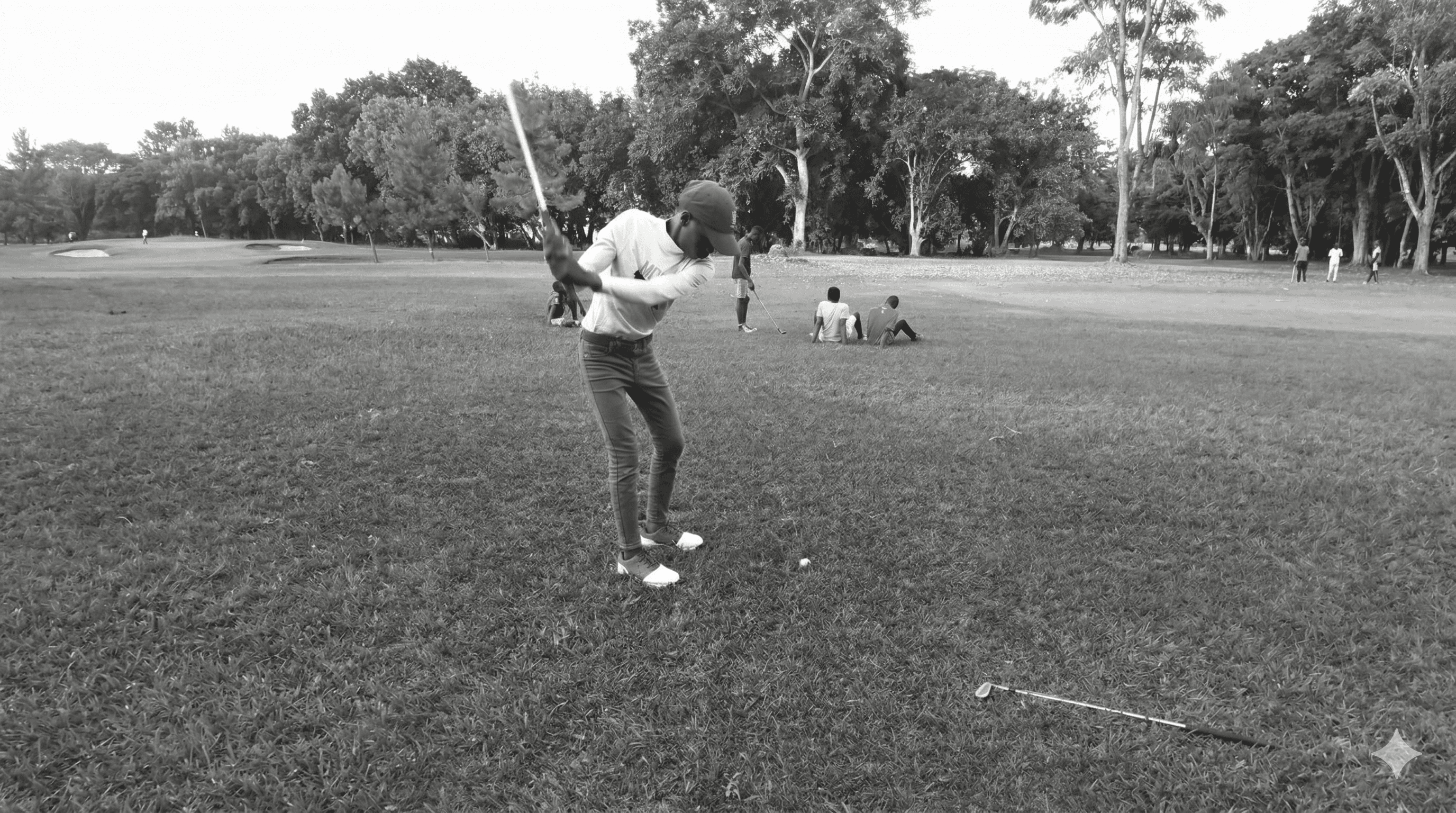

Marvin Kibirige’s first clubs weren’t shiny new clubs. They weren’t nice used clubs either.
They weren’t even an old mishmash of clubs. He dreamed of a mishmash of clubs. He dreamed of a single club, in fact.
Marvin Kibirige’s club wasn’t even really a club. It was a stick whittled from a Cariptus tree. He never played on a golf course until he was a teenager. Instead, he beat balls he’d found from a local club in a field near his grandmother’s home in Uganda.
He is a professional golfer now. I didn’t learn that from a leaderboard or a highlight. I heard it from a friend grinding on the pro circuit in India. He told me about a night outside a hotel, where he saw Marvin sitting on the steps—out of money, and running out of time.
“You have to talk to Marvin,” Jhared Hack told me that night. “His story is unbelievable.”
The next night, I did.
Marvin had made it from those hotel steps to the next stop on the India Pro Tour, thanks to a loan from Jhared and Dominic Piccirillo. We spoke for 40 minutes—interrupted only by the spotty Wi-Fi in the hotel room the three of them shared. Jhared was right. It was unbelievable.
When Marvin was just a month old, his mother left him at his grandmother’s small house in Namulonge, Uganda. She never came back. Marvin’s grandmother was his hero, but life wasn’t easy.
At six years old—yes, six—Marvin was introduced to golf as a ball spotter at the Mary Louise Memorial Club near her home. He would race ahead of members at the all-white club, tracking down their wayward tee shots. He earned about 1,000 Ugandan shillings per round—roughly 28 cents in U.S. currency.
In much of East Africa, golf courses were remnants of another era—places of privilege set apart from the surrounding communities. Children didn’t grow up dreaming of playing them. They grew up working on them.
By age 10, Marvin had moved from ball spotter to caddie—a promotion that came with a raise. Each round brought in around 3,000 Ugandan shillings, just under one U.S. dollar. Every bit of it helped keep food on the table. Somewhere along the way, he fell in love with the game.
But golf clubs and balls weren’t an option for a family living day to day. So Marvin and his friends made their own. They whittled clubs from Cariptus trees and played with balls they found—some more honestly than others.
Each day after work, they’d head to a nearby soccer field and hit balls until dark. If a club broke, it didn’t matter. There were always more trees.
Marvin played cross-handed. None of them noticed. None of them cared. They were just happy to be out there, sending balls across the field.
At 12, everything changed. A member at the club where Marvin caddied, Edward, took him to the range. It was the first time he’d ever swung a real golf club. The first time he’d hit balls anywhere other than a soccer field. He still played cross-handed. Edward fixed that. The talent was obvious.
Not long after, Marvin entered his first junior tournament. He played with three clubs—a driver, a 7-iron, and a putter. And he won. Golf became his life.
The club gave him access to the range, and he took full advantage—300 balls in the morning, 300 more at night. He borrowed a mishmash set of clubs from a friend—Bridgestone irons, a Callaway driver, and a Titleist three wood. He would use them for years.
At 16, Marvin Kibirige made the Uganda National Golf Team. Seemingly impossible for someone raised by his grandmother, introduced to the game in a soccer field with a stick, and playing with borrowed clubs.
And now, he was representing his country. Marvin’s game kept improving. He became the best player on the National Team. Still using borrowed clubs.
He asked the team for a set of his own. They told him they were coming. They never did.
In 2019, he’d had enough. A tournament in Egypt was on the schedule. Marvin said he needed new clubs—the same promise they had yet to fulfill. He didn’t go. His time on the National Team was over. And he still didn’t have clubs. Marvin’s uncle had supported him throughout his career, and the two began talking about the next step. Turning pro.
In 2021, Marvin did just that. And his uncle delivered what the National Team never could: a new set of clubs. Marvin started his professional career with brand-new Titleist irons.
The transition to professional golf is difficult for most. It was no different for Marvin. Playing local events in Uganda, he missed his first six cuts—many of them by a single shot. The veterans gave him a nickname no pro wants: “By One.” A daily reminder.
In his seventh event, he stood on the 18th hole needing a par to make his first cut. He hit a perfect drive. From 90 yards, his approach settled 15 feet from the hole. It looked over. Then his playing partner spoke up.
Wrong ball.
They had been playing the same model, and Marvin had hit his partner’s ball. Two-shot penalty. Now, he needed to hole out from 80 yards just to make the cut. Marvin Kibirige made his first cut as a professional by holing a wedge for par. It was the jumpstart his career needed.
Over the next year and a half, he won eight times across Africa, making a name for himself in the small pro golf community of East Africa. Then, last year, tragedy struck.
Marvin’s grandmother, Sefoloza, passed away. As we spoke about her, I asked what he called her at home. Marvin misunderstood my poorly worded question. His answer was perfect.
“She was my mom, my dad, and my hero.”
Her passing made Marvin realize he needed to chase his dream beyond Africa. His grandmother would have wanted it that way. “I feel her presence with me every day,” Marvin told me.
Joshua Seale, another player representing Uganda, encouraged him to try the Pro Golf Tour of India. So Marvin found a bank willing to sponsor him, saved what he could, and flew to India for the first time. The $2,000 the bank provided was nearly gone before he even teed it up—airfare, entry fees, and the weekly costs of Q-school.
He was thousands of miles from home. He knew no one. He had never played in India. Making it through would have been a long shot. He finished second.
At the final stage, he did it again—finishing ninth and earning full status for the season.
Earlier this month, Marvin made his first three cuts—finishing 24th, 29th, and 51st. But in this game, it takes time to get paid.
After the second event, Jhared Hack—fresh off a win the week before—walked out of the clubhouse and saw Marvin sitting on the steps. Out of money. Hack knows that feeling. He’s lived it. And he wasn’t about to let Marvin’s season end there, two events in. A loan was worked out. Flights booked. Hotels secured. The season continued.
When we spoke again, Marvin was back in Uganda, renewing his visa. Short on cash, still chasing it. He told me he’d be back in India when the season resumed. “One way or another.”
Marvin Kibirige was left at his grandmother’s house as a newborn. He learned the game with a tree branch. He became a multi-time winner in professional golf.
He’ll be back.
Defying the odds is what he does.

Comments
...