
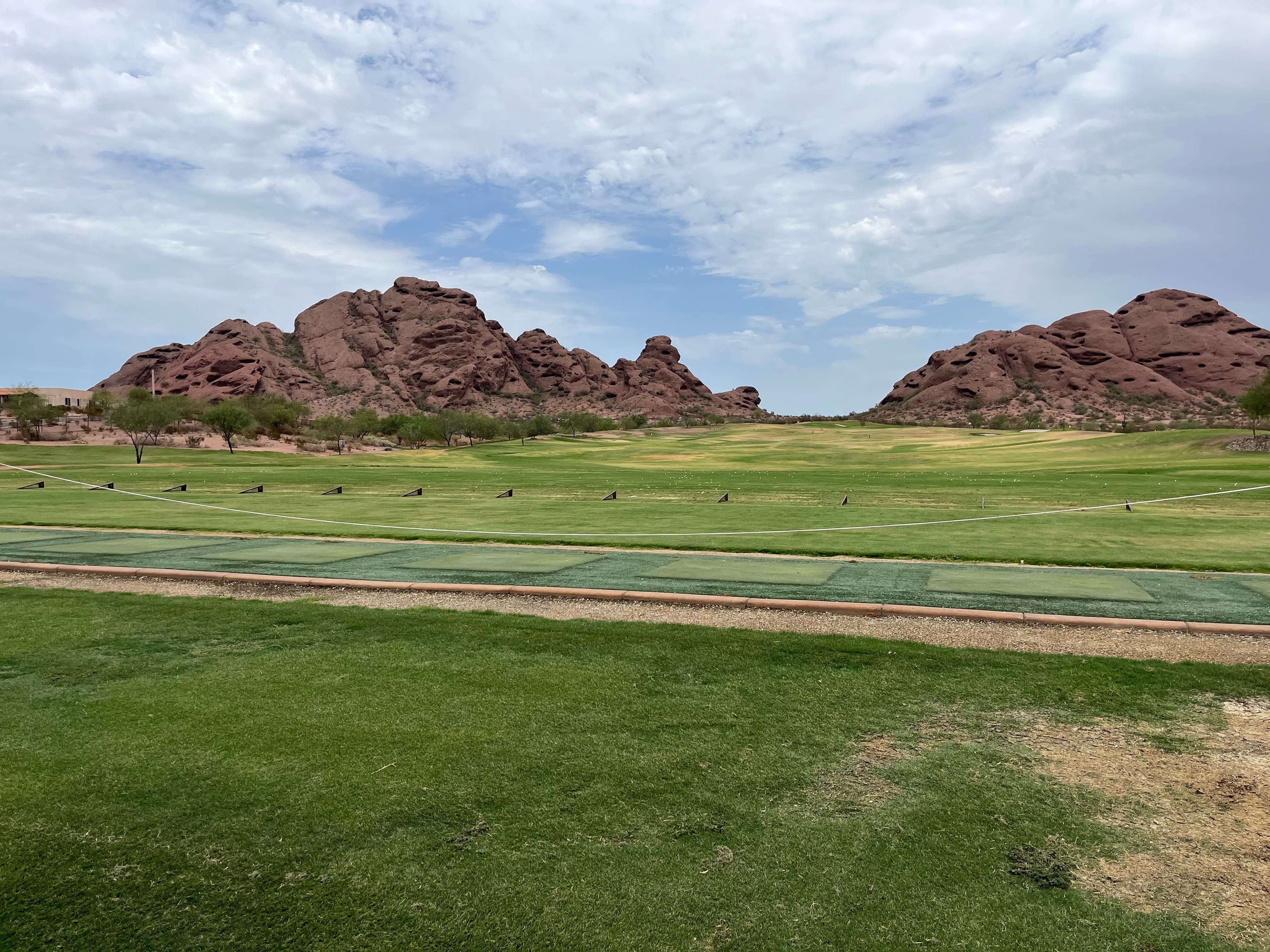

The 115-degree heat felt like an oven. On the 15th hole at Papago Golf Course during the Arizona Open, I marked my ball and started cleaning it when I realized that while the Callaway 2 was marked similarly to my ball, it was missing my initials. I had played that ball twice—for my second and third shots—on the par-5. The heat intensified, making me dizzy.
It’s been a summer of managing nagging injuries, making practice difficult and causing me to withdraw from multiple tournaments. The year, so far, had been marked by missed cuts and a dwindling bank account. I’ve tossed and turned in budget hotel beds trying to alleviate the pressure of hip and back injuries. Rest rarely came, leaving me wondering why I was showing up at all.
After two consecutive years of finishing runner-up at the Arizona Open, however, I hoped to get back on track. I sleep better during tournaments close to home and figured the blistering heat would also keep my body loose.
I told my playing partners on the 15th green that I’d played the wrong ball. The ball had been sitting down in the Bermuda rough and only the Callaway and a blue dot on top of the logo were visible as I approached it. There was another group in the same area playing the adjacent 14th hole when I found it. Maybe a player from that group played my ball and I played theirs?
My playing partners were Ping’s Vice President of Fitting and Performance, Marty Jertson, and 2024 U.S. Four-Ball champion Sam Engel. You couldn’t ask for a better group. Both were playing well and despite the scorching heat, having a good time. My wrong-ball dilemma was going to rob the group of momentum. From their reaction, I could tell they felt for me—you never want your playing partner defeated by an earnest mistake—knowing this penalty could end my tournament hopes.
I found a rules official, told him what happened and laid out my theory.
“If we can’t find your ball or confirm it was played by another player, it’s a lost ball and you’ll have to go back to the tee,” the rules official said.
As I headed back past the group behind us waiting in the fairway, I faced a potentially ruinous situation. Would I have to go back to the tee and be penalized? I was 1-under for the day and it occurred to me that this might be the last time I was under par for the round (hell, maybe the tournament!). My bank account was alarmingly low, credit card bills would need to be paid in the coming weeks and we had to take my six-year-old, Miles, back-to-school shopping. Oh, and did I mention my wife is due with our second child in November?
A couple weeks earlier, I returned home from a missed cut at the Colorado Open. Before I’d even set my bags down, Miles told me that when he woke up the following morning, he expected me to be at the golf course practicing. For a moment, I felt proud that he was learning to push back against disappointment with hard work. When he added that he needed a new bike and knew he wouldn’t get it unless I played better, I realized his motivation wasn’t entirely intrinsic. Also, somewhere along the way, he’d become attuned to my stress. That wasn’t something I wanted him to feel. But our little talk served its purpose, adding motivation.
After playing the wrong ball, was I now an underdog to make the cut? Was this going to be another entry fee lit on fire? I pushed these thoughts out of my mind as I approached the area where I had played my shot and another group played the 14th.
“You guys see a spare ball around here?” I asked.
“Actually, there’s one down there,” a player said, pointing 15 yards ahead in the other fairway. It was a glimmer of hope. How did I miss that?
A sense of relief came over me as I saw my initials on the side of the ball. I told the official this was my original ball.
“OK, you now have a two-stroke penalty for playing the wrong ball,” he said. “You’re hitting four.”
“Even though I played the wrong ball twice?” I asked.
“Yes, it’s just a two-shot penalty for playing the wrong ball. It doesn’t matter how many times you hit it on this hole,” he said.
More relief. I was 240 yards away. The hot wind was gusting in my face, stinging my now-optimistic eyes. The pin was accessible in the front of the green. A good swing here and I’d escape with minimal damage. I had three holes remaining after this. I could still get back under par if I escaped with a bogey.
I pulled 2-iron from my bag and planned a lower-flighted shot. A few deep breaths and a smooth swing. I caught the center of the face and the ball never left the flag.
I couldn’t see it land or bounce, but as I headed back to the green, I knew I’d averted disaster. Engel gave me an encouraging reaction.
“It almost went in,” he said. “It nearly caught the hole as it rolled by!”
There was a ball about 15 feet behind the hole, only slightly longer than the putt I’d had earlier before I picked up the wrong ball. The putt was downhill, downgrain and downwind. It was going to be speedy, but all I had to do was get the ball started on the correct line.
I felt confident in the read and brushed the ball down the hill. It looked good the entire way and disappeared. When the putt fell, I laughed.
“You’re not going to believe what I made there,” I said.
“Was that a…par?!?” Engel asked.
“That was a par,” I said.
The group had a good chuckle.
“Karma’s a funny thing in this game,” Engel said.
I smashed a drive to 70 yards from the green on the 442-yard par-4 16th. A low, spinning lob wedge gave me a good look under the hole. Standing over the putt, I thought I was going to make it, but the putt didn’t break and the ball slid by. Walking off the green was when I felt a surge of confidence for the first time this entire year: I believed again.
I made a bogey on the closing hole after a bad wedge shot to shoot even-par 70, but I told my wife, Sarah, that a breakthrough was imminent. Maybe it would come the following day, or the day after that. I got my answer on the opening hole in Round 2, when I hit my second shot from 120 yards to three feet for an opening birdie.
Even though a handful of putts grazed the hole but didn’t fall, I capped off a 5-under 65 in Round 2 with an eagle at the last. I entered the final round four shots back of the lead and would play alongside former PGA Tour member, Jim “Hard K” Knous, and former Sun Devil and three-time All-American, Cameron Sisk.
The morning was cloudy and the range balls soared effortlessly over Papago’s prehistoric buttes around the property. I’d have to play the best round of the year to catch the leaders, but just being back in the mix heightened my senses. Nerves tingled for all the right reasons.
I hadn’t managed final-round nerves in months, and I got off to a frustrating start. After a bad wedge shot and a couple missed putts, I was 1-over through my first six holes. I rallied with birdies at 7 and 9. Knous made four straight birdies to start the back nine and I had someone to chase.
My birdie putt burned the edge on 13 and my tee shot bounced into the desert on 14, the ball settling on a rock. I couldn’t tell how big the rock was or how deep it was buried in the ground, and I wasn’t going to find out before the shot—I’d been penalized enough already. I chose a pitching wedge for the 157-yard downwind shot.
My irons are four-year-old Apex MB blades covered in character. Scrapes and wear marks fill the soles and faces. The paint in the iron numbers has come off. The clubs aren’t shiny or sleek. Other golfers might assess the clubs are a few range sessions away from retirement. Maybe that’s why I like them. They’re beat up but aren’t beaten. They refuse to quit.
The desert rock on 14 gouged the leading edge of my pitching wedge, but the ball flew true and stopped 25 feet from the hole. The club looked like it had stopped a bullet—the sole had a hole in it and the bottom of the face was warped. The club had helped me make cuts on the PGA Tour and struck a critical shot to secure a SoCal Open win a few years ago. I desperately wanted to make the birdie putt to honor the club’s sacrifice, but the ball dove low at the last moment and missed.
I birdied the par-5 15th, burned the edge on 16 and lipped out for birdie on 17. The closing five-footer for birdie fell for 66, securing a four-way tie for second with Knous, Trevor Lewis and amateur Ethan Butters. Amateur Cody Massa started the day tied for the lead and made six birdies in the final round to win by four. An amateur winning the event meant the three professional runners-up would split first, second and third-place money—more lucrative than a solo runner-up.
It wasn’t a win, but it felt every bit as good. The $16,300 check would cover back-to-school shopping. It would cover bills and rent for a while. Importantly, my game was back.
I’ve been incredibly lucky to have played pro golf for a long time but found out how torturous the game can be this summer. It’s been a while since I remembered that golf can also be joyful.
As I pointed my car toward home, I thought about the celebratory hug I’d soon share with my family. My eyes welled and tears fell, washing away a long summer.

Comments
...