
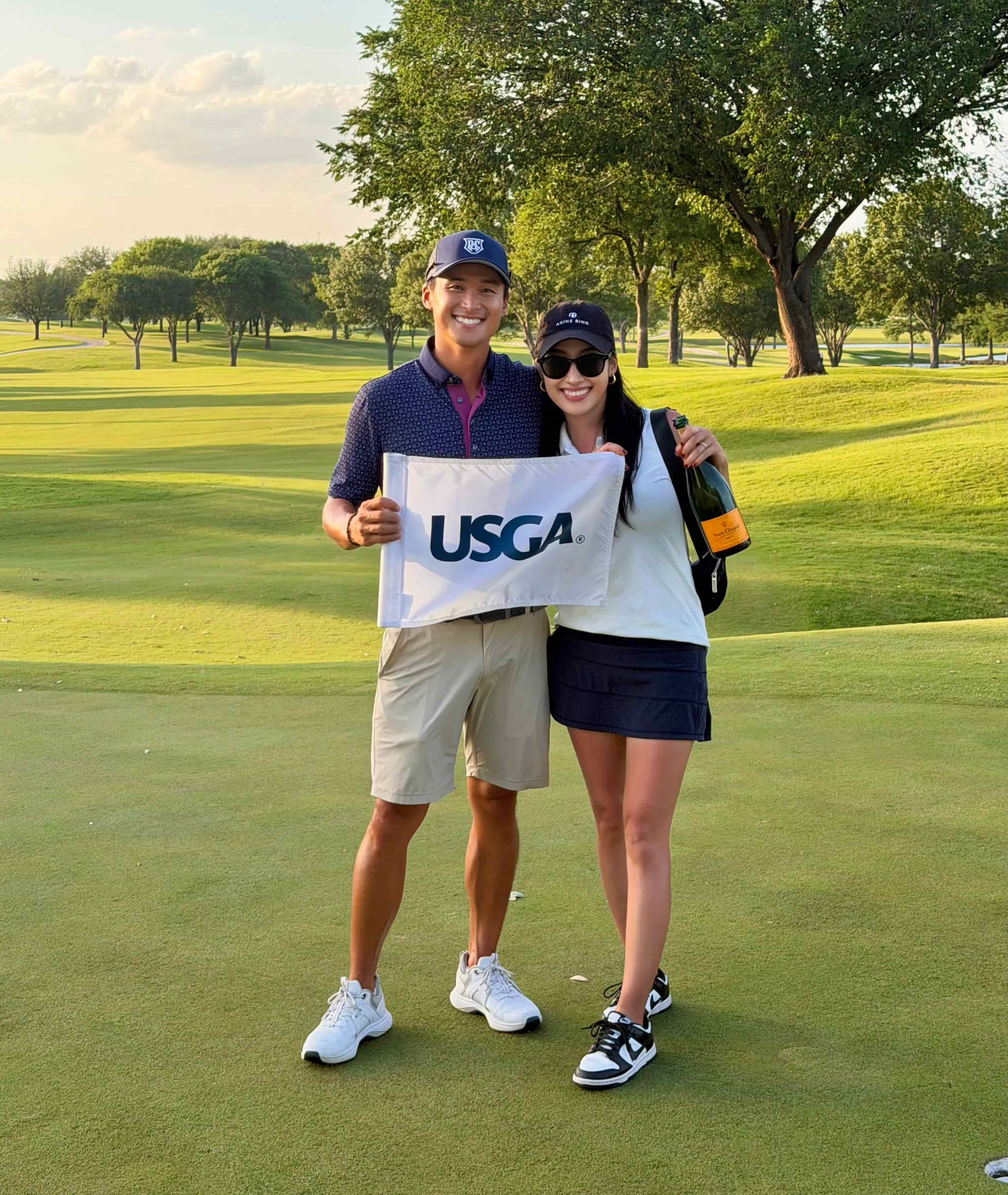

TK Kim and his wife, Jin, sat on the couch, replaying the putt again and again. It was 2 o’clock on a Tuesday morning.
The tears had already come and gone—five or six times, maybe more. Both had lost count. Every time they thought it was time to call it a night, one of them would recall another detail from the final hole of U.S. Open qualifying, and the emotions would come rushing back.
“We didn’t want to go to sleep,” Jin told me days later, her voice cracking. “We were afraid we would wake up and it wouldn’t be real.”
Just hours earlier, TK had poured in a long putt on the final hole to earn a spot in the U.S. Open at Shinnecock Hills Golf Club. For most fans, it was simply another player claiming one of the 100 or so available spots in the field. For TK, it will provide the opportunity of a lifetime.
The 35-year-old Kim has endured just about everything professional golf can throw at someone: injuries, sponsorship deals that ended badly, financial uncertainty, and countless near-misses that would’ve forced a lot of people to walk away.
TK Kim was born in Seoul. His father, Tae-Ho Kyoung, owned a driving range and had played professionally himself. Like so many kids, TK picked up the game simply because he wanted to spend time with his dad. He quickly became good at it.
No surprise, because TK was talented enough athletically that by age 11 he was being recruited to join the Korean national ski team. That’s when his parents told him he needed to pick a sport: golf or skiing. Each would come with sacrifice.
Since he was about 4, TK had spent months at a time in Hawaii with his aunt, whom he considered a second mother. But if he wanted to seriously pursue the game, his parents believed Hawaii’s mild climate would provide him the best chance at a future in golf.
TK chose golf. He was 11 when he left for Hawaii. Three years later his aunt adopted him.
She owned a successful Japanese restaurant in Maui, and when Kim talked about her, it was obvious their bond ran deep. But there was one problem: Restaurateurs don’t get weekends off.
As TK began winning tournaments in Hawaii, opportunities to play bigger junior events on the mainland cropped up. Talk about growing up fast. He would travel alone, tagging along with a rules official or another player and his family. He learned how to be independent.
But that came with a price. In 2008, he qualified for the U.S. Public Links and the World Juniors, two events that were scheduled at almost the same time. Kim opted for the Public Links. The problem was that he didn’t think to withdraw from the World Juniors, and when he was listed as a no-show, college coaches saw a kid they feared was immature and undisciplined.
Still without a college on the eve of signing day, TK finally got a call. It was Kevin Burton, the coach at Boise State. He had seen TK play at the Public Links alongside Rickie Fowler and a Boise State player. When Burton offered a scholarship, TK accepted without hesitation.
He had never visited the campus. He knew little about the golf program. A few months later, as his flight began its descent into Boise, Kim stared out the window at the miles and miles of farmland below.
“What have I done?” he remembered thinking.
Kim’s plan entering his freshman year was simple: play well, then get the hell out of Boise and transfer to a powerhouse program. Instead, he fell in love with the place.
He connected immediately with Burton, embraced the underdog mentality of the program, and built close relationships with Graham DeLaet and Troy Merritt, both of whom later reached the PGA Tour.
Kim played in every event during his junior and senior seasons, recorded a win and piled up multiple top-25 finishes. Then, after his senior season, the moment Kim had been chasing since he was 14 finally arrived: he turned pro.
He was back in Korea visiting his parents when he heard about PGA Tour China Q School. With the support of a Boise State booster, he scrambled to enter, asking a friend in Boise to ship him his clubs.
He finished 14th at Q school, and like that, he had somewhere to play.
The rookie season went well. Kim made nine cuts in 11 starts, recorded two top-10 finishes and earned almost $170,000. The next two seasons produced more solid golf, including a runner-up finish, and the growing belief he was steadily moving toward the PGA Tour.
Then came 2017 and a wrist injury that would stall his career for parts of the next three years.
Doctors struggled to pinpoint exactly what was wrong. One suggested rest, so Kim took four months off. He returned and made it just 24 holes before the pain came roaring back. He was sidelined for another seven months. Another doctor. Another visit with no diagnosis.
He returned prematurely for Japan Tour Q school, but the wrist kept him from being competitive. After missing out there, Kim flew back to Korea desperate for answers. The family visited five doctors. One finally identified the issue.
Kim had injured his hamate bone and also suffered cartilage damage in his triangular fibrocartilage complex, better known as the TFCC.
Rest was the recommended treatment, but Kim had run out of patience.
“I think it’s over,” he told his parents of his career in golf.
He returned to Boise and, for the next seven months, rarely left his apartment. Without golf, Kim felt lost. He withdrew from friends and started drinking heavily. Four or five nights a week, he said, he would polish off a bottle of liquor.
Finally, in 2020, in the middle of the COVID pandemic, Kim decided it was time to leave pro golf behind and return to Korea. He headed to the airport believing he was on his way to the start of a new life. Turns out he was no longer welcome in his homeland.
Because Kim had become an American citizen, he was not considered a Korean citizen. And because of COVID travel restrictions, he wasn’t allowed into the country.
Kim applied for a visa, a process he was told would take no more than a month. In the meantime, he moved in with a friend and his wife.
As for the wrist, for the first time in years, he was finally pain-free.
Kim started playing money games with DeLaet and Merritt and came away pleasantly surprised: he could still play. The dream he thought was over slowly started creeping back.
The visa process dragged on for months. Then one afternoon at a driving range in Boise, Kim’s life changed forever.
“There aren’t too many Koreans in Boise, Idaho,” TK said about meeting Jin. “She was beautiful, and by our third date I knew she was the one.”
Eventually, Kim gave up on the visa and decided to chase professional golf again. In his first event with Jin tagging along, he lost in a playoff at the Reno Open. It would become the start of a remarkable run of near misses.
Kim used the money from Reno to enter a Korn Ferry Tour Monday qualifier. He lost in a playoff. He went to another Monday qualifier. Lost in a playoff again. Then another. Same result.
At the Utah Open, Kim finished runner-up, losing to an albatross on the 71st hole.
At the end of 2021, Kim took a major step forward by making it to the final stage of Korn Ferry Tour Q school, giving him conditional status. But his 135th-place finish left him with only limited status and another season mostly spent chasing Monday qualifiers. The next season he got into just two Korn Ferry events, missing the cut in both.
After getting financial backing from a family member, Kim moved to Dallas, hoping he would finally find some stability for his career. Instead, the arrangement collapsed after disagreements over how the money was supposed to be used.
Fortunately, members at Dallas Athletic Club took Kim in, giving him a place to practice and helping him stay afloat. Jin moved to Dallas with him, and the couple married in 2024. She refused to let his dream die.
An accountant by trade, Jin worked relentlessly to grow her business, eventually taking on PGA Tour players as clients. The couple lived in a small townhouse outside Dallas before Jin made another sacrifice. She emptied her retirement savings so they could buy a home with a garage large enough for TK to build a practice setup.
“We are in this financial position because of me,” TK told me through tears, struggling to explain what his wife’s belief in him has meant.
And finally, all of the sacrifice led TK and Jin back to his home course in suburban Dallas.
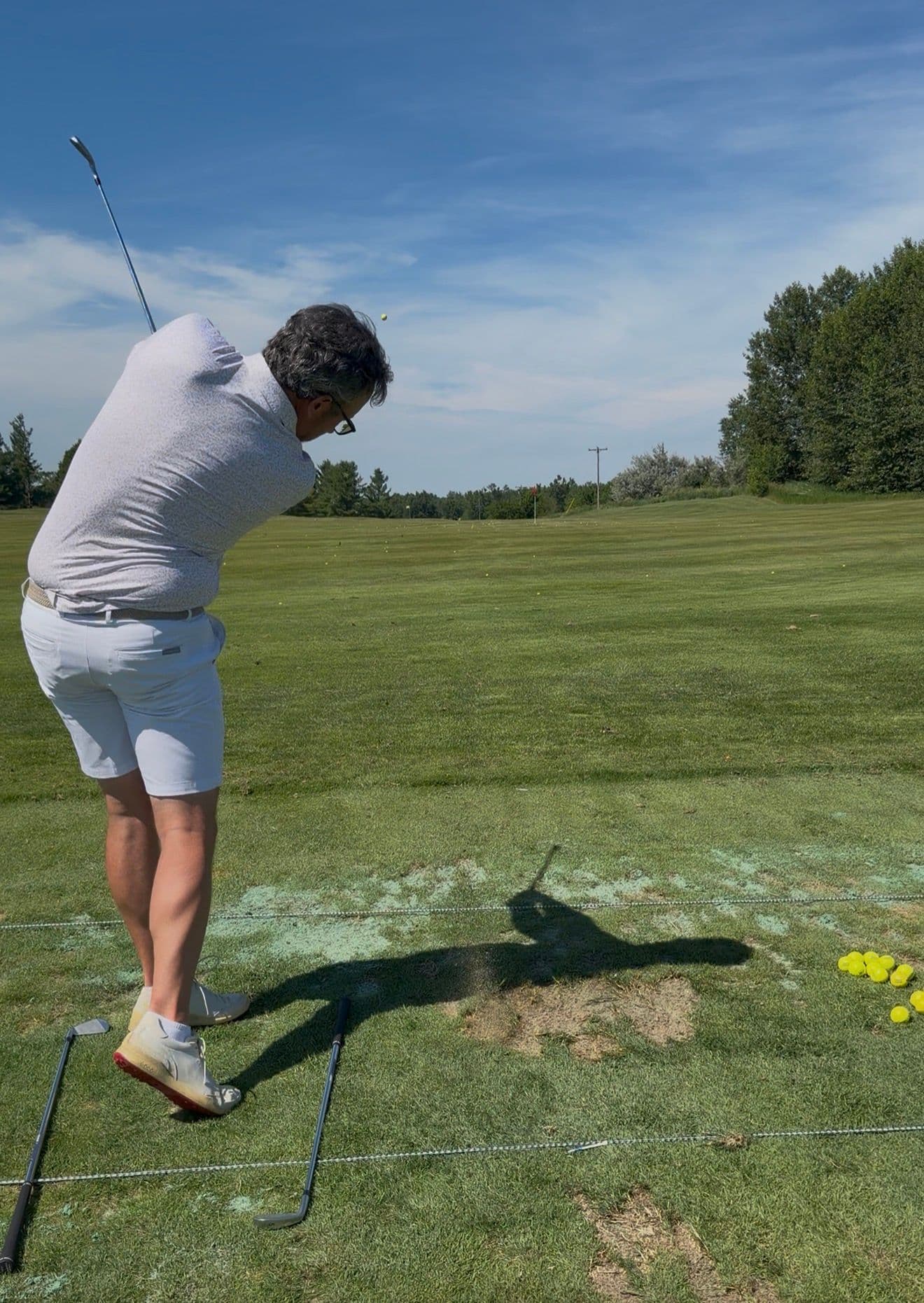
TK opened with a 67 on the Gold Course at Dallas Athletic Club, putting himself in strong position to claim one of the nine available spots at the 36-hole qualifier for the U.S. Open. Jin was there, as always, walking every hole.
His second round nearly unraveled early on the back nine when TK bogeyed two of his first three holes and slipped outside the qualifying number. But he fought back.
He steadied himself with a routine birdie at the par-5 13th. Then at the par-3 14th, he stuffed a 9-iron to 12 feet and poured in the putt. At the 15th, he almost holed his approach shot. Three straight birdies.
Just like that, Kim had climbed comfortably back inside the number.
But very little in TK Kim’s professional career has come easily. This would be no exception.
The difficult par-3 16th on the Blue Course is framed by water. After splashing the tee shot, he dropped to his knees and grabbed his head. His heart racing, Kim gathered himself and poured in a sliding 15-foot putt to save bogey. He was still inside the number.
He appeared to steady things with a good drive and a solid approach at the par-4 17th. But the birdie putt came up woefully short and the par attempt never touched the hole.
The number of Dallas Athletic Club members following Kim’s group had swelled with every hole, and by the time he reached the par-4 18th, about six dozen spectators lined the fairway and green. The same members that had helped him become a member at the Club. Among them were people who had helped him with entry fees, or travel, or place to stay before Jin moved to Dallas.
A par would put Kim in a six-for-one playoff. A birdie would send him straight to Shinnecock Hills. A bogey? Nobody wanted to think about that.
Kim hit a good drive but only a mediocre approach, leaving himself nearly a 40-foot putt with what he estimated had close to six feet of break.
The only video of the putt is grainy footage shot from far away inside a golf cart. You don’t see the ball disappear into the hole. But you hear the screams immediately. You see Kim violently pump his fist. And you immediately understand what just happened.
After the putt dropped, TK walked directly to Jin. The tears flowed.
TK called his parents back home in Korea. He said his dad doesn’t show much emotion, but his mom told him he had a drink that night, something doctors advised against, in celebration. It was validation to TK that his father understood the moment.
He called DeLaet, too. Graham will be at Shinnecock and said, “I can’t wait to cheer him on.”
Back home in Dallas, TK and Jin are still trying to comprehend it all. Was it a dream? Far from it.
TK Kim has a tee time in the 126th U.S. Open.`
Comments
...