
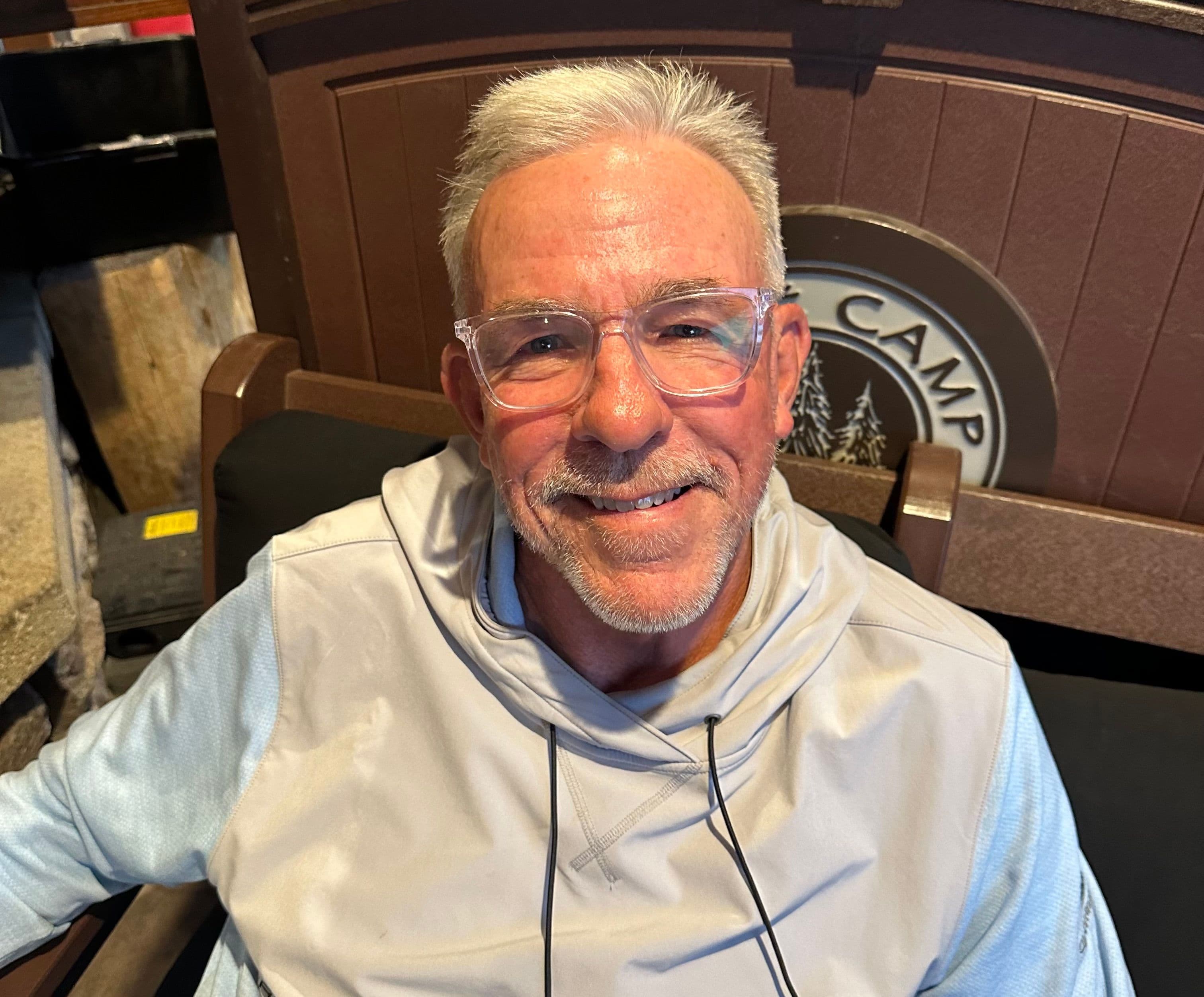
Matt Moore died before sunrise on a Wednesday morning last month, his final days spent at home in the company of family and close friends. It was a peaceful, intimate end for a man who lived so much of his life in the spotlight. It’s exactly how he would have wanted it.
The name might not ring a bell, so indulge me as I tell you a little about Matt. He was the retired president and CEO at Shelter Insurance, a man who diligently worked his way up the ranks during a 35-year career with the company. An Arkansas native with an aw-shucks demeanor, he was a friend and mentor to many, a guy with a buttery golf swing but a not-so-silky putting stroke. And if you followed SEC football a dozen or more years ago, you might remember Matt as a referee who popped up on your TV screen on Saturdays in the fall.
Tory and Drew Smith had no idea who Matt was when they moved into their home along the 14th fairway at the Club at Old Hawthorne in Columbia, Mo., in 2010. The Smiths were still getting settled in their new abode when on a Saturday that fall Tory looked at the TV to find a familiar face on the screen. “That’s our neighbor,” a startled Tory told Drew. “I saw him outside cutting his grass the other day.” Sure enough, the authority figure in the white hat was the same shirtless middle-aged man who had been pushing a lawnmower in the front yard of a home a couple of fairways away, behind the 11th green at Old Hawthorne.
Drew and Matt would meet soon after on the golf course, and the Moores and Smiths became fast friends, traveling the world, breaking bread together, playing cards, listening to music Matt cranked up so loud it rattled the windows in the Moore basement. (Matt loved his music and could play a little piano.) The couples were so close that Tory was at Matt’s bedside with Rhonda, his wife of 44 years, when he died on Aug. 19 after an eight-month battle with glioblastoma. Matt was 70. He also leaves behind his daughter, Mallory Smith, and her husband, Tom, his son, Matt Jr., and his wife, Megan, and five grandchildren.

Matt’s death has rocked so many because he impacted countless lives over the years. He was a compassionate, selfless man who quietly undertook philanthropic efforts large and small, some of which his closest friends weren’t aware of until after his death. He would make anonymous donations to charitable organizations, sometimes without even telling Rhonda. He was most concerned about how you were doing.
“He was never really interested in himself,” Mike Hackmann said during a recent Zoom call with Drew and Jason Hoffman, Pat Neylon and Matt Schwartz (a.k.a. JB), three other close friends and Old Hawthorne neighbors. “He didn’t want it to be about himself.”
Mike recalls his initial encounter with Matt, in 2008 as the two were walking down the first fairway at Old Hawthorne. Matt asked Mike what he did for a living, only to become embarrassed when Mike mentioned they worked for the same company. Never mind that Matt was higher up the corporate ladder or that the two men worked in different departments in a large firm. Matt had high standards; there was no reason not to know who Mike was.
Matt took Mike under his wing at Shelter, just as he did with JB. “He legitimately cared about us,” JB says while noting Matt always seemed to sport an infectious smile.
The group was brought together by their shared passion for golf: weekend rounds, club tournaments, emergency nines. Matt was a regular at The Stampede, the rollicking member-guest at Old Hawthorne. Though he had no shot at winning, he wasn’t shy about competing in the long drive contest, and he would hold court on the clubhouse patio during the Friday night festivities, often regaling us with stories about his experiences as an SEC side judge and referee, a career that would span 16 seasons.
Putting was always a struggle. Over the years, Jason estimates Matt went through 10 or more putters: mallets, blades, broomsticks, you name it. He never had trouble finding a tournament partner, but playing in alternate-shot formats didn’t come without its challenges. The objective: Get Matt two feet from the cup, if not closer.
Dad dern was his phrase of choice when he got mad. Pat recalls a particularly hot and humid day when there was no drink cart on the course. After his round, Matt walked into the grill room and groused he “had nearly thirsted to death.” Pat also remembers the day Matt put in a call to Rhonda as the group was making the turn. He then disappeared into his house after finishing the 11th hole, reappearing on the 12th tee with freshly baked chocolate chip cookies in hand. And that infectious grin. Always concerned about everyone else.
Or as Tom Quick, Matt’s close friend, SEC crewmate of four seasons and roommate on the road, put it: “He deflected the attention. His management style of discipline within the crew was certainly different than most.”
Matt and Tom met at a referee clinic on the football field at the University of Missouri in the spring of 2011. Rhonda and Mallory were there. They all made an immediate connection, and when Tom moved from the Big 12 to the SEC that fall, he was assigned to Matt’s crew. Tom remembers getting a call from Johnny Hibbett, the retiring official he was replacing, who told him, “I'm so happy for you because you're not going to a crew, you're going to a family.”
Early in their first season together, Matt and Tom made the 550-mile drive to a game in Starkville, Miss. It was a get-to-know-one-another trip. The conversation was so deep and inspiring that Tom never remembers turning on the radio. At one point, Tom says he “used some really choice words” to suggest that while the crew had a ton of talent, it needed to step up its game. He believed a pep talk was in order and that Matt was the guy to deliver it. “I told him he needed to jump in some people's chili,” Tom recalls, “He looked at me, smiled and said, ‘I want to step on everyone's toes without scuffing their shoes.’ I've never forgotten that.”
But the conversation was about so much more than football. They talked about their families, the commitment required to be away from loved ones and how to juggle their day jobs, about their journeys in life. “Looking back,” Tom says, “I was introduced to an angel that day, somebody who was on this planet to make sure that others have a better life.”
Matt was the crew chief for the 2010 SEC championship game. He worked a BCS game. He was the 2015 recipient of the Bobby Gaston-Ed Dudley Spirit of Officiating Award, which goes to the SEC football official who best “exemplifies the qualities of integrity, wisdom, insight, humility, a great attitude, service to God, his family, his community and his fellow officials.” He hung up his whistle at the end of the 2014 season, and upon retiring from Shelter in 2021, he transitioned to a role as a collaborative replay official at SEC headquarters in Birmingham, Ala. Although none of his friends knew it at the time, he was on the collaborative reply crew for the 2024 national championship game. The stories about Saturdays spent on football fields around the SEC were fascinating, as were his rules interpretations when most of us believed an official got a call wrong. This football fanatic soaked it all in.
He had a calm about him, and as he huddled his crew at midfield moments before kickoff, the roar of the crowd ringing in his ears, he would remind his fellow officials they needed to focus, that they needed to stick together for 60 minutes. Then, Tom says, he would break the tension by perhaps poking fun at a crewmate’s haircut. Everyone broke the huddle with a grin. “He just had that magic of making people feel comfortable,” Tom says.
Matt recreated a last-play game-winning kick at Ole Miss, mentioning his job was to keep his eyes trained on the kicker as the ball sailed through the night sky, looking up only after confirming no penalty had been committed. “I knew whether the kick was good or not by how the crowd reacted,” he said.
Tom vividly remembers an Alabama-Arkansas game the two worked in their first season together, when on the last play of the first half, the crew huddled to untangle a complicated play. After “nailing the call,” as Tom put it, Matt turned on his mic to explain it all to the crowd and a national television audience. But in the excitement of the moment, he fumbled his words. He cursed himself as he sprinted to the tunnel at the opposite end of the field.
“He’s like, ‘Doggone, shucks, man. I kicked that announcement. We did everything so good and I just didn't do my job.’ For a hundred yards,” Tom recalls. “We got to the locker room, and I looked at the rest of the crew and I said, ‘Look at these dumb sumbitches. You're our best option. Do you want to put the microphone on them or me?’ We had a motto on the crew from that day forward: Don't get mad, get better.”
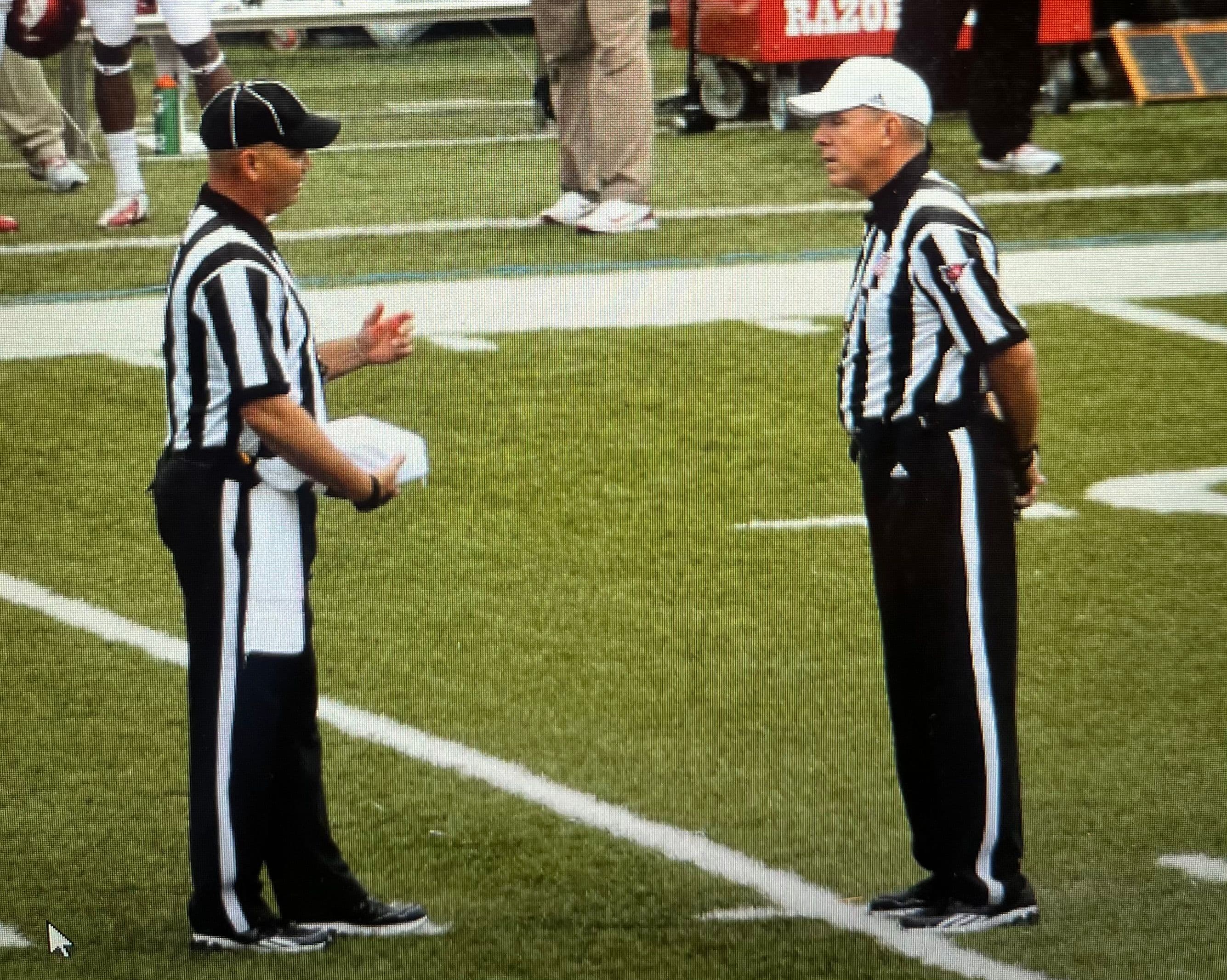
During an LSU-Ole Miss game in 2012, Matt made arguably the most memorable call of his career, to the folks at Old Hawthorne anyway, after the crew flagged the Rebels for a personal foul. “Hitting above the helmet,” Matt announced, before catching himself. “Gosh, doggone it!” Matt would say to Tom later. Over the years, a lot of chuckles were had at Old Hawthorne for hitting above the helmet, Matt laughing along with everyone else.
Then there was the 2011 game between South Carolina and Auburn, when the Gamecocks rolled out their camouflage Wounded Warrior ensemble. On problem: The camouflage was so good the numbers on the jerseys were indecipherable. Matt and Steve Spurrier had the utmost respect for each other, and Matt told the Old Ball Coach a wardrobe change was in order. Spurrier got in Matt’s ear, as did the none-too-pleased CEO of Under Armour. The Gamecocks switched to their black jerseys.
Perhaps my favorite story? During an Arkansas game, quarterback Ryan Mallett repeatedly complained to Matt that he needed to throw a flag for roughing the passer. Matt would simply shake his head as he looked down at the fallen quarterback. Then after a downfield pass fell incomplete later in the game, Mallett popped to his feet and screamed for Matt to throw a flag for pass interference. Matt was quick with the response, saying, “That’s not my call. I have to keep my eyes on the quarterback to make sure there’s no roughing the passer.”
The stories were so rich that in 2015 I told Matt we should collaborate on a book. I went so far as to have a dummy cover designed, including an image of Matt from the 2010 SEC championship game. Whistleblower: Reflections of a 16-year veteran of SEC football battles, I called it. Drew, Mike, Pat and Jason joined me in encouraging Matt to dive in, but deep down, we all knew he would never bite, because he knew he would have to share the dirty war stories. Matt could never do that, although among friends he did reveal his disdain for one particular SEC head coach.
No surprise, but the retirement came without fanfare. Tom sensed the end was near after an overtime thriller between Georgia and Georgia Tech in late November. Upon returning to their hotel room, Tom was understandably on an adrenaline rush and noted what a joy it was to be part of such an epic game. “Matt looked at me and said, ‘You know, I left the duck blind and my family to come down and do this game,’” Tom recalls.
And that was that. Matt called his last game at the 2014 Citrus Bowl. Tom and the other crew members got the news in a call from someone in the SEC office. “That’s typical Matt,” Tom says. “He did not want it to be about Matt.”
Life was good. After his retirement from Shelter, when Matt and Rhonda weren’t traveling with friends, they were hopping in the car to check in on the kids and grandkids. Then, after church and brunch on a Sunday last November, during a rare weekend off from his SEC duties, Matt became disoriented while driving home, telling Rhonda he was lost and didn’t know where to go. He pulled the car over, and Rhonda drove him directly to the hospital. On Tuesday, Matt participated in the weekly SEC officials Zoom call, slipping on a blue hoodie to hide his hospital gown, fully intent on being in Birmingham that weekend. But the diagnosis came back the following day—a grade-four brain tumor—and surgery was scheduled almost immediately.
The news hit me especially hard because my wife, Leigh, is a brain-tumor survivor. She was diagnosed in August 2011, around the time we met Matt and Rhonda. From that day forward, without fail, every time I saw Matt, his first question was always, “How’s Leigh?” When he saw Leigh, he always greeted her with a hearty hug and told her he was praying for her. (Not unlike Tory’s experience, Leigh remembers hearing a familiar voice on the TV announcing a penalty in a Southern drawl, “Holdin’, No. 72” and exclaiming, “That’s Matt!”)
Now Matt was dealing with the deadliest of brain tumors. What a cruel twist.
We exchanged a couple of texts. He mentioned he and Rhonda wanted to chat at some point. “Know you have walked this road!” he typed. “Love ya, brother!!”
Matt underwent multiple surgeries, endured radiation and an exhausting medication regimen, and was a candidate for clinical trials. Drew and Pat kept me updated as best they could, and when they shared news, I would shoot Matt a text. Having experienced a lot of what Matt and Rhonda were going through, I decided that was the best way to communicate. I was confident he would call when he was ready. His texts were always upbeat. Sometimes he would reply with simply a heart emoji. In the end, we never had that conversation. That makes me sad, but it makes sense now. Matt never wanted to make his ordeal about himself. And aware that Leigh was dealing with recent health issues of her own, I’m guessing he didn’t want to burden us with his own problems. It was Matt being Matt.
Tom got the news in a phone call. “TQ, I’ve got a problem,” he remembers Matt saying. He couldn’t comprehend what he had heard, but during a subsequent phone conversation, Tom tried to lighten the mood. Matt may have been an excellent conversationalist, but wire him up to a microphone and put him in front of a rabid SEC crowd and a national television audience, and he would occasionally stutter, to the point Tom jokingly called him Mel Tillis.
“Matt, I’ve got it figured out,” Tom told his dear friend. “God’s got it scripted. They're going to go in there and get whatever they’ve got to get so you don't stutter. He laughed so hard.”
During treatment, there were the expected ups and downs. Matt and Rhonda celebrated his 70th birthday in style, in Greece in June. In late July, not a week after having another tumor removed, Matt hit a couple of shots in the men’s league. “It is really hard to believe how good he looks six days after brain surgery,” Pat texted me. He added that Matt and Rhonda didn’t leave without asking Pat how Leigh was doing. Drew says Matt would get on his phone and research his condition. He anxiously awaited test results, hoping they would signal a turn for the better, only to get news he didn’t want to hear.
“When he got kicked out of the last trial, I think that killed his spirit,” Drew says. “I think he decided enough was enough.”
Matt was admitted to the hospital one last time over a weekend, taken off his meds and sent home on Monday. Hospice was called in. He died not 48 hours later.

Card night was always spirited, to the point the Moores and Smiths kept a log of the scores, with the occasional random comment jotted down in the margin. The game was always 11-point pitch, and it was always Matt and Tory against Drew and Rhonda. The evening of Jan. 2 was no different. “Stay alive. No matter what occurs, I will find you,” was scribbled early in the game. It is a quote from The Last of the Mohicans, although Drew and Rhonda can’t remember the reason for the comment. Later, Psalm 46:10: Be still and know that I am God. And finally there was this: “Sugar-free ice cream is sweet!”
That last comment must have come from Matt, because on this night he had gotten the urge to sample something sweet. Sugar was bad for him, so he had cut it out of his diet. But he at least wanted something that tasted sweet. So he and Drew headed to the grocery store, hoarding an assortment of sugar-free items—ice cream, candy and the like. The trip home on a bitter-cold winter night took a curious turn when Matt asked Drew to drive down a darkened out-of-the-way street.
Drew was confused, but curious. “What are you looking for?” he remembers asking Matt.
They pulled up in front of a modest house with a portable basketball goal in the driveway. And that’s when Matt shared a long-kept secret. Nobody knows how long he had been on his crusade, but he would occasionally cruise through neighborhoods and check the status of basketball nets. If a net was gone or even just shredded, he would go to the back of his car for one of the handful of nets he always had at hand and leave it on the goal, even present it to the unsuspecting kids if they happened to be outside.
“He was so cagey,” Drew says. “He didn't want people to know he was doing these things. He was like, ‘Don't you tell anybody I’m doing this.’ And then he said I needed to do it for him if he wasn’t around. He loved doing that. He didn't do it for notoriety.”
Sure enough, this rim was in need of a net. Drew returned the next morning and dropped off some new nylon. (At Matt’s celebration of life service, basketball nets were made available for all takers. One is already hanging in a Columbia classroom, the teacher sharing Matt’s story with her students and writing in a note to Rhonda that was posted on social media: “Matt’s net is a permanent fixture in my classroom, and one day it’ll go home with someone who needs a net for their rim.”)
To understand why Matt Moore would engage in so many random acts of kindness, you have to know where he came from. He had a somewhat hardscrabble childhood growing up in Little Rock, Ark., raised by his mother after his father abandoned the family when he was five. His father didn’t depart, however, without buying Matt a membership to the local Boys Club. The center would become his safe haven, a place to hone his athletic skills and forge friendships. Baseball was his best sport, and he would play four years at Arkansas Little Rock as a lanky left-handed pitcher.
So maybe it was those experiences at the Boys Club that reminded him never to forget where he came from. Or perhaps it was the memory of shooting hoops with friends on a court a few blocks from home, the net often tattered if not missing, meaning a ball that went through the hoop might bounce into an adjacent creek.
More recently, Matt was the co-developer of a multimillion dollar community center that opened this year in one of Columbia’s underserved neighborhoods. He served on the board of a foundation whose mission is to empower minority- and women-owned businesses. In June, the Boys and Girls Club of Columbia put Matt’s name on its new clubhouse. He was there for the ribbon-cutting ceremony, beaming from ear to ear. Last week, he was posthumously inducted into the Missouri Boys and Girls Club Hall of Fame, becoming the first Columbia resident to be so honored.
“I’ve been blessed to have great people around me,” Matt told COMOBUSINESSTIMES.COM in 2025, months before the diagnosis. “I try to get along with everyone, and I just want to keep doing more.”
And so he did.
About a month before he died, Matt made one last visit home, to Arkansas, to see family and friends. He wasn’t feeling well and didn’t want to go, but Rhonda insisted, believing that being around his grandsons might lift his spirits. Once there, however, Matt didn’t feel up to leaving the hotel room. But Mallory wanted to see her father, so one evening she confiscated her mother’s room key and headed over. Upon hearing the door crack open, Matt announced, “I’m sleeping.” That didn’t deter Mallory. They didn’t visit for long, maybe 15 or 20 minutes, but one of the last conversations between a father and daughter was an especially memorable and impactful one.
“I kept asking him to fight,” Mallory says, “and he kept saying there is no fight, that this is all God’s plan. I said, ‘Dad, one of the things you keep saying is that you want to continue to share God’s word and to mentor people.’”
Without hesitation, Mallory says her father replied, “But Mal, I can still do that. I can still mentor people after I’m gone.”
He already is. One basketball net at a time.
Mark Godich worked as a senior editor at Sports Illustrated and The Athletic during a career in sports journalism that spanned more than 40 years. He is the author of the 2013 book Tigers vs. Jayhawks: From the Civil War to the Battle for No. 1.


Comments
...